
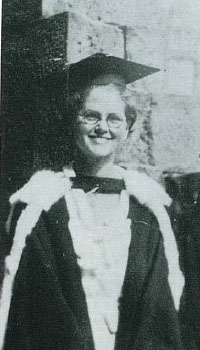
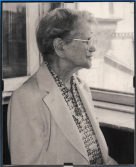
Rosemary Goldie
This is not a history of Pax Romana. Others have written that and will write it again. It is not even the history of a period, but only “glimpses” of Pax Romana as I lived it between thirty and fifty years ago. Some of these are experiences shared by others, although the number grows fewer each year. Some are just memories I would like to share.
Vaduz 1938
The inter federal Assembly had been in session, April 30 – May 1st in the Principality of Liechtenstein. The future Prince Franz-Josef II had met the delegates over a friendly meal. We were standing, Rudi Salat and myself, on the crisp snow that covered the street of the village capital. A peaceful spot in Central Europe, where war clouds were gathering rapidly. In a few months I would be returning to Australia; the Administrative Secretary was entrusting me with the task of taking the “message” of Pax Romana to the distant continent. No, too soon, for by the time the University Catholic Federation of Australia was founded in Sydney, all contact with the headquarters of Pax Romana in Fribourg had been cut off and would remain so for years. We affiliated through the Secretariat set up in Washington – headed by the “legendary” Ed Kirchner – after the war had broken out in Europe while delegates were gathered in Washington for the Pax Romana Congress; the story has often been told. Rudi Salat, as a German, could not return to Europe and, when the U.S. came into the war after Pearl Harbour, he left for South America. There he helped to set up movements of university Catholic Action wherever a Nunciature could offer him hospitality.
How did I come to be in Vaduz? I had arrived in Paris in October 1936 on a Scholarship (after a six-week journey from Sydney to London). A recommendation from a Jesuit in Sydney to an S.J. in Paris brought me to the Dominican, Fr. Marc Dubois, Chaplain to a little group of women students of the Sorbonne. I discovered that, as a member of this group, “Veritas”, I was automatically a member of the French Federation of Catholic Women Students, and thereby, member of Pax Romana – of which I had never heard. I was to hear much more of it, however, for the 16th Pax Romana Congress was to be held in Paris, 28 July – 3 August 1937, on the occasion of the International Exhibition. For the first time, too, the Congress was to be preceded by Study Days outside Paris, at the College of Bouffemont. As Pax Romana’s first Australian, I was invited. For me, these were days dense with new experiences.
In this hey-day of Pius Xi’s “Catholic Action”, the study at Bouffemont was on the “Formation of the Student” in all its aspects – religious, philosophical, cultural, professional, social – and the task involved for Pax Romana. It was here, too, that I had my first taste of the “liturgical renewal”, with the experience of the “dialogue Mass”.
The Congress which followed in Paris, with about 700 participants, was all too relevant to present-day problems: the subject was “Unemployment among young university graduates”. The photos of Bouffemont and Vaduz, with the delegates grouped around the President, Max Legendre, are proof enough that the time was becoming ripe for Pax Romana, set up originally as a student movement, to “produce” a movement of professional people and “intellectuals” generally.
After the Congress in Paris, I was so fully part of the Pax Romana family that, the following year, since no other woman student was available, I went to Liechtenstein as an accredited delegate of the French Federation.
London-Paris -Fribourg, 1945-46
June 1945 saw me back in London, en route again for Paris and the Sorbonne — with travel problems too, and through, war-torn Europe which students today would have difficulty In imagining. A conference in Oxford for the Centenary of Newman’s Conversion had made it possible for a number of Pax Romana people to reach England; I was able to attend a Regional Conference held in London to pick up the threads after the disruption of the preceding years. Others have told the story of the work done during those years by the Secretariat in Fribourg, in collaboration with Protestant and other agencies: a work for refugees and war victims that was to continue for several more years. I heard only at second-hand also from the Congress or ani ed at Salamanca in June 1946 by the wartime President, Joaquin Ru1z-G1menez. In the meantime, I had arrived in Paris. and from there I traveled to Fribourg In August 1946 as a delegate of UCFA to the Jubilee Congress for the 25th Anniversary of Pax Romana’s foundation; and before the Congress, to the Assembly at Estavayer-le-Lac where the refounding of Pax Romana as IMCS and ICMICA was finally decided.
Pax Romana had grown internationally despite — and even through — the war. A new phase was opening, but one which would no longer have the dynamic, inspired, and inspiring leadership of “Abbé” Joseph Gremaud, the much loved Swiss priest who had been General Secretary since 1924. He was resigning for reasons of health, although he would remain as IMCS Chaplain until his death in March 1953.
I was to live with a “new phase” day by day when I came to Fribourg to join the Secretariat in December 1946. Ed and Louisa Kirchner were returning to the U.S.A. (after some epic work on Ed’s part for the refugees in Europe), and an English-speaking staff-member was badly needed. I had done most of the work I had come to do in Paris and cherished the illusion that I could finish a doctoral thesis while working Pax Romana. The thesis never happened (but something was eventually published) and the four months I had offered became six years. General Secretaries succeeded one another in IMCS: Fr. Joseph Schneuwly, later General Secretary of UNDA, (Association Catholique Internationale pour la Radio et la télévision) Bernard de Hoeg (died 1984), later representative of the Netherlands with UNESCO; Benard Ducret, for many years now, General Secretary of the University of Geneva. Rudi Salat was with us also — he had finally been reunited with his family during the Fribourg Congress – until he returned to Germany in 1950 for important posts in foreign service, and later in UNESCO. In the meantime, Ramon Sugranyes de Franch was bearing the burden of the day in the initial stages of development of ICMICA, and the two Secretariats worked closely together in the old offices of the rue St. Michel.
My first inter federal Assembly as staff-member was held at Anzio, south of Rome before the memorable “Roman Days” at which IMCS and ICMICA came formally into being, linked in “Pax Romana”. Traveling from Fribourg in Holy Week, we reached Milan without mishap, only to find we had missed our connection for Rome. However, there would be “room” on an extra train leaving at 5. p.m. There was, but in a carriage from which seats and fittings had been removed and the military occupied the corridor. During the night, an umbrella went up in the corner where the rain was coming through the roof; while perched on my luggage, I tried to protect Father Schneuwly’s round Roman hat from the prevailing dust. We did arrive, at 11 a.m . were rescued by the FUCI and taken to our Directing Committee meeting a the Retraite du Sacre -Coeur on the Janiculum.
At the Anzio Assembly, we met for the first time, Mieczyslaw de Habicht. He had come from London as a substitute for a member of the Polish Federation in exile. A few mothers later he joined us in Fribourg to take over the Relief Service. In 1951 he was appointed Permanent Secretary of the Conference of Catholic International Organizations, a post he held until he came to Rome in 1967 as Associate Secretary of the “Consilium de Laicis”. He died in 1982: one more important “witness” of the post-war pre-conciliar Church and of the Second Vatican Council.
The World Scene
It is difficult to recapture today the “feeling” of immediate post-war Europe. Switzerland was something of an oasis in war-weary Europe; but the problems of the world pressed in on us from all sides. I had arrived from Australia among the ruins of London, and I spent all 1946 in Paris under wartime conditions where food and housing were concerned. After the war, Pax Romana’s budget was largely dependent on a grant from the American Catholic Relief Services. It was made for refugee students and intellectuals, but half of it could be used for administrative purposes. This stopped abruptly after a few years, leaving the Secretariat in a state of trauma.
But our problems were not only financial. The big menace was communism. At Anzio, the debate was furious about relations with Marxist-inspired student organizations. “Peace” was an ambiguous term. appropriated by communist propaganda. The necessary “democratization” of University had ideological overtones: students claimed their rights as “young intellectual workers.
There were hopes, too, and new horizons. The ONU was getting underway. Before leaving Pans in 1946 I was part of Pax Romana’s delegation to the first conference of UNESCO – we were received at the Nunciature by Mgr. Angelo Roncalli The firs: stirrings of decolonization were already felt by the colonials powers”. India was Independent from 1947. The Pax Romana Journal, which was revived in a multilingual form in 1947, carried feature articles on Human Rights, on UNESCO as seen by Jacques Maritain, on the movement for European unity in its various forms, on Christian Unity, on the international and supranational commitments of Catholics In general and of Pax Romana in particular.
Pius XII, mostly through his Substitute, Mgr. Mantini was giving full encouragement to the international apostolate. The pre-war Conference of Presidents (barely tolerated by ecclesiastical Authority) became in 1951 the Conference of Catholic International Organizations, with statutes approved by the Holy See and a Permanent Secretariat. Pax Romana played an important part in this revival. It is hard today to realize that, before Vatican II, the Conference of C.I. 0 . was the only regular forum where world problems were discussed in all their amplitude as a challenge to the “apostolate” (today we would say “evangelization”).
The Holy Year 1950 was the first great coming together in Rome after the war of Catholics from all over the world. During that year Pax Romana held its Congress in Amsterdam and received the famous Message from Pius XII: “Be everywhere present in the vanguard of the intellectual combat, at this time when the intellect is endeavoring to grasp the problems of humanity and of nature in the new dimensions they will have from now on·. The Congress was followed by the Pilgrimage to Rome, where Mgr. Mantini addressed the pilgrims at the Colosseum: “Faith is a strength – The only language which unites us”. The following year, Pax Romana gave its full collaboration to the First World Congress for the lay Apostolate, organized on the initiative of Vittorino Veronese, President of Italian Catholic Action and Vice-President of ICMICA.
The University Apostolate
If world problems and the aftermath of war provided the conteX1 in which we lived, our day to day activity, apart from the Relief Service, was mainly concerned with the “University apostolate”; and, after the division of Pax Romana, this meant specifically, for the IMCS, the student apostolate. Not only “Catholic Action” in the strict sense. Our vision of Pax Romana was wider, as sanctioned even by our Statutes. The members of IMCS were national Federations, recognized by the Hierarchy, “comprising catholic university groups which give the student an integral formation and develop in him the apostolic spirit”; they must not be “active in party politics”. But there was no mention of any “mandate· from the Hierarchy, and no specific method of formation was prescribed. Developing the “apostolic spirit” was interpreted rather widely. Affiliated Federations included, together with Catholic Action groups, traditional organizations, more civic than apostolic in scope, from German-speaking countries, all-embracing associations of Catholic students like the Newman Clubs of Societies of English-speaking universities, coordinations of various groups — professional, missionary, “apostolic” — like the French Federation of Catholic Students Federations of students in exile, etc.
It was hoped that “Mutual fraternal understanding” would, by osmosis, bring a more apostolic spirit to the social-minded Federations, while it was acknowledged that C. A groups could profit from the secular and civic experience of the less “directly apostolic “. From Pax Romana, moreover, came the urging to develop the “social consciousness” of all students. The “politicization” of ’68 and after was in the far future.
This variety of the Federations, linked in a wide-open student community, is evident in the news pages of the Pax Romana Journal, “A mari usque ad mare”. It is illustrated also in a series of booklets published up to 1951: on “Catholic Action” (presented in much the same terms as the Vatican II Decree on the Lay Apostolate); on “Professional Economic and Social Sciences, Pharmacy, art); on the “Intellectual Apostolate” (proceedings of a Study Week held at Fatima in 1951); finally, University for Christ, the University Apostolate in Action. This last publication reflects the work of a Study Week on “University Catholic Action”, held at Mariastein, Switzerland, in January 1949 – the meeting at which for the first time, it had been possible, in a spirit of reconciliation, to bring together German students and those of previously “occupied ” countries. The groups presenting their activity in the booklet are from several European countries, but also from Brazil, Mexico, Paraguay, and Peru, with “echoes” from Australia, India, and South Africa. Much would seem remote to the successors of the student leaders of the ’40s and ’50s, but the need for solid Christain formation is something which is perhaps being rediscovered today in the search for “new” approaches to pastoral work and “evangelization” in the University.
Pax Romana-IMC$ and International YCS
In spite of the stress which IMCS laid on “Catholic Action”, it was in the name of C.A — its orthodoxy and orthopraxis (in modern terminology) — that the YCS (Young Christian Students) came into conflict with Pax Romana after the creation in Paris, in 1946, of the CIDI (International Centre for Documentation and Information, later Secretariat of the International YCS). Pax Romana sought the collaboration of the YCS groups, some of which were affiliated to the international movement. YCS groups in France, Belgium, and Canada were represented at Mariastein. The Study Days were indeed strongly marked by the “Cardijn approach”, with its see-judge-act method; but identification could not go so far as the dogmatism of one Canadian participant who wondered how the FUCI (Italian Catholic University Federation) could possibly call itself “CatholicAction” if it did not use the “team method” as developed in YCS.
Later IMCS suggested that the international YCS Centre provide a “Catholic Action Service” within Pax Romana. But no modus vivendi could be found. YCS continued to call in question any character of “Catholic Action” in so heterogeneous a body as Pax Romana. The situation was further complicated by the problem of double representation of Catholic university students at the international level, where YCS sought independent association with UN, UNESCO, etc.
Pax Romana suggested representation for school-level YCS; but this would have been contrary to the YCS concept of the unity of the student milieu: school and university. Relations were practically suspended from 1947 to 1955.
It is outside the scope of these “memories” to trace the process by which friendly relations were later established, with increasingly close collaboration -starting from Latin America, and largely through the profound spiritual influence of the Chaplain to the two movements, Father Buenaventura Pelegri. But, looking back to before the ”process”, it still seems to me regrettable that, in confrontation with the International YCS, Pax Romana-lMCS should have come more and more to define itself as a “movement” in the specific sense in which YCS is – necessarily – a “movement”, geared towards the action of a particular kind. In the process, especially when the thrust became more exclusively one of “liberation”, groups whose first priorities were different, dropped away. The meeting-ground for all forms of “university apostolate” as the “university community in the Church” no longer existed.
“Are women present in Pax Romana?”
This was the title of an article I wrote for the Pax Romana Journal in December 1950. The answer was, obviously, that they were present, and by no means inactive. But it had been an important innovation, a few months earlier, when IMCS decided to keep a place on its Directing Committee for a woman student; Anne Hope became Vice-President: an Oxford student from South Africa, who was later too involved for comfort in the anti-racist struggle. Before the war already, in 1931, women students and graduates had come together at Grenoble to discuss their experience at the university and the professions. A Sub-Secretariat for Women Students was set up, which organized studies and holiday camps. It was revived after the war and worked for a few years under the generous and efficient leadership of the Swiss medical doctor, Rose-Marie Loretan.
The immediate occasion for my article was, however, a meeting which had been held at La Verna on the invitation of the Italian FUCI and “Movimento Laureate”, after the Holy Year Pilgrimage. Discussions were serious: once again on university studies and on professional life — illustrated by experience in teaching, law, architecture, medicine, pharmacy, natural sciences, etc. — and on women’s political role.
Already the question was being asked: what do women bring to the professions, to all the fields newly open to them? Women’s international responsibilities, in relation to UN, UNESCO, etc., were presented by the Belgium founding member and “stalwart” of ICMICA, Rosa Delrue. This aspect had been discussed already at a meeting held in Amsterdam after the World Congress; a meeting convened by IMCS and ICMICA, together with the Presidents of the World Union of Catholic Women’s Organisations and of the International Federation of Catholic Young Women and Girls, following an initiative of mutual consultation taken earlier by Pax Romana. The inevitable tension between University and “intellectual” commitment on the one hand and the claims of “women’s concerns” on the other, was not so easily resolved; but at least, better relations were established and more mutual understanding.
La Verna was not, however, to be remembered only — or mainly — for earnest discussions on intellectual and professional commitments. Reflections on biblical and theological themes were introduced by two Benedictines: Dorn Giulio Fohl from Luxemburg, and Dorn Agostino Mayer, today Cardinal Prefect of the Congregations for the Sacraments and for Divine Worship. Spiritual “animation” and much of the joyous hilarity were due to the presence of Mgr. Emilio Guano (“Don Guano”), Chaplain to the “Movimento Laureate” and Secretary to the Chaplains of IMCS (later, International Chaplain). Pax Rornana’s “vision” of women and their participation in Church and society would certainly not give entire satisfaction to feminists today, but it was not marked by any overly traditional attachment to “womanly roles·. Women said Don Guano at La Verna, “must give themselves a basic human and Christian formation”; formation is impossible if we think “too exclusively” of its feminine aspects.
Other meetings were to follow. After Paris 1951, Heverlee (Louvain) in 1952. It was at Heverlee that I met for the first time a woman who felt herself strongly called to be a priest! It was there, too, that Maria de Lourdes Pintasilgo, then President of University Catholic Action for women students in Portugal, had her first contact with Pax Romana. In 1956 she was to make history as the first woman President of Pax Romana, before making it, in 1979, as Prime Minister of Portugal.
A “spirituality” for Pax Romana
Don Guano did not “animate” only the meetings of women students and graduates. His contribution, in-depth and breadth, to the life and work of Pax Romana was incalculable.
In the immediate post-war years, the task of reconciliation would have been far more
difficult without his presence. In a lighter vein, his dramatic rendering of the student ballad “Santa Caterina” was legendary. Also his propensity for placing liturgical prayer at odd moments of Pax Romana meetings on land or sea or in the air (the charter flight from Montreal after the 1952 Congress, with “technical delay” at Gander, will remain in the annals of Pax Romana!).
But meetings were too few and far between. After the “Roman Days” of 1947, a few students and staff members asked Don Guanio to supply more frequent nourishment. The “Group of Pax Romana” came into being: an informal network of students and graduates (never more than about 60), scattered around the world and recruited by personal contact. At irregular intervals, from Pentecost 1947, there were circular letters, in French and English, often related to the high points of the liturgical year. but also on particular subjects. Nothing “exotic”; an essential and a biblical spirituality: God, Christ, the Church, Faith, Hope and Charity, the Family, Culture, Truth, Friendship, Pax Rornana’s international task… The circulars – but not the spiritual lin – came to an end in 1962, when Don Guano became Bishop of Livorno, and increasingly involved in the work of the Council – until in 1965, he contracted the disease which was to bring about his death in 1970. In the decisive stages of work for the future Gaudium et Spes, Mgr. Guano was chairman of the drafting group, and the finished Pastoral Constitution bears traces of his thought.
In the first circular, for Pentecost 1947, Don Guano introduced himself: “A priest who has for some time been exercising his ministry among university students and graduates, and has had contact with Pax Romana… He believes, as you do, that the love, the seeking, the shared knowledge of the truth, are among the fundamental means and, at the same time, the ultimate aims of communion among peoples. He believes, as you do, that Christian faith in God as Father, with all the vitality of hope and love deriving from it, is the greatest force for uniting men, the most important and beautiful goal which men and peoples must unite and work together to achieve”.
Looking back… and forward
After the itinerant World Congress of 1952 on “The Mission of the University” (Toronto-Montreal-Ottawa-Quebec), I left the staff of Pax Romana to work in Rome for the Permanent Committee for International Congresses of the Lay Apostolate (SPECIAL). I spent my last days in Fribourg, in September 1952, excavating in the archives of the years from 1919 (Pax Romana in preparation) to 1930 (when Rudi Salat came to the Secretariat and order began to reign); going through box after box stuffed, pell-mell, with the material of more or less historical import.
Two “pearls” surfaced. One, the circular dated 1921 which announced the definitive “solution” of Pax Romana’s financial problems! The other – history indeed -, in the last box, the hand-written letter in which Baron de Montenach recounted to Abbe Gremaud his “pilgrimage” through Europe, in the last years of the previous century, when he tried to bring Catholic student groups together in what was finally to become, in 1921, Pax Romana.
Contact with Pax Romana by no means ended with my departure for Rome. Many more “glimpses” would be possible. I would like to recall only three more activities, each in its way emblematic for the task, and growth, of Pax Romana.
Today the holding of an IMCS Seminar in Asia would be ordinary administration. It was a pioneering endeavor in 1954, a year before the Bandung Conference, at which the peoples of Asian and Africa were to affirm their place in the world for the first time. Thanks to the untiring efforts of Fr. Pierre Ceyrac, S.J. It was possible for the Seminar to bring together at Loyola College, Madras, from 10 December 1954 to 2 January 1955, nearly 100 students from 12 countries. My own part, as an informal Pax Romana agent, had begun some months earlier when I was traveling to prepare for the First Asian Meeting for the Lay Apostolate (Manila, 1955). In the Pax Romana Journal for February 1954, I am reported as having come to Madras for preliminary planning, after taking part in the First African Leaders’ Meeting for Lay Apostolate, held in Uganda, where I had “worked fast and furiously establishing contacts for Pax Romana with African students and chaplains”.
Another pioneering activity of Pax Romana gave me my first ecumenical experience. February 1955, a Conference on “University, Culture, and Human Community” was Jointly organized by Pax Romana and the World Student Christian Federation at the Ecumenical Institute of the World Council of Churches (Bossey, Céligny, Switzerland).
The carefully worded letter in which the Bishop of Geneva, Lausanne, and Fribourg, Mgr. François Charriere, General Chaplain of Pax Romana, explained the nature and aims of this meeting to the Pro-Secretary of State, Mgr. Domenico Tardini is proof enough of the novelty – and potential risk – of such an undertaking at the time.
Finally, during the preparation of the Synod on Laity (twenty years after Vatican II), it seems appropriate to recall the “Fribourg Meeting” of July 1960. On the initiative of Ramon Sugranyes, then President of ICMICA, an international group of 22 participants (4 priests, 3 women) met for the purpose of contributing to the work of the Council. Mgr. Charriere accepted to preside over the meeting. There was no set agenda. The subjects discussed included the status of the laity in the Church, Christian unity, Church-State relations, peace, and the international community, the Church in the newly emerging nations. The findings, duly forwarded to Rome, may or may not have had an impact on the Preparatory Commissions; the Meeting was in any case an expression of Pax Romana’s role in the Church’s mission to a changing world. The world has indeed changed since then in many ways; the Church also, in its process of “aggiornamento”. Among the changes are new channels and means of expression for the contribution of those called to be in a special way the “thinking” faithful — mainly, but not exclusively, laity. There are not only Diocesan Synods, Pastoral Councils, National Commissions of all kinds; there are also Pontifical Councils for Laity, Family, Culture, Pontifical Commissions for Justice and Peace, Social Communications… There remain, however, necessary tasks open to the free initiative of the “Christifideles”. Pax Romana-lCMICA has 40 years’ experience of taking “lay” initiative – not exclusive of clergy and not unblessed by Hierarchy. It has its place in this new context: a place wider than its structures, wide open to cultural change and exchange, but deeply based in the love of Christ, living in and through His Church for the world of today and tomorrow.
* * *
Rosemary Goldie (Australia) joined Pax Romana in 1937 when studying in France. She started the first movement in Australia and later worked in the Friborug office from 1946 – 1952. Later, she was an auditor at the Second Vatican Council and the first lay woman to work in the Vatican Curia.
Originally published in Pax Romana, Mémoire et Espérance, Memory and Hope, Memoria y Esperanza: 1947-1987 : Pax Romana MIIC-ICMICA. (Geneva: Secrétariat général Pax Romana, 1987).
Leave A Comment
You must be logged in to post a comment.