
“Transforming ICMICA-MIIC in the Spirit of Synodality and Digital Innovation”.
2025 Plenary Assembly
Every four years, following her Statutes, ICMICA holds her Plenary Assembly. This year, she holds her 38th Plenary Assembly. Members can participate online or in person.
Due to its hybrid nature and the global presence of the movement, we only have a limited common time of three hours a day for everybody to be connected at the same time. Therefore, our statutory session will be split across Saturday, the 15th (1:00-4:00 p.m. GMT), and Sunday, the 16th (1:00-4:00 p.m. GMT).
This gathering is the highest decision-making body of our movement and is a vital occasion for renewal, discernment, and commitment to our common mission as Catholic Intellectuals and Professionals. The Assembly will focus on the following theme: “Transforming ICMICA-MIIC in the Spirit of Synodality and Digital Innovation”.
Therefore, it will serve the key purposes:
- Define the orientations and priorities of the Movement for the next four years.
- Strengthen our unity, synodal engagement, and global solidarity.
- Elect or re-elect the leadership of the Movement: The President, Vice-Presidents, Treasurer, and Secretary General.
Venue: Seminário Nossa Senhora de Fátima Alfragide in Lisbon, Portugal.
PREPARATORY SESSIONS FOR THE ASSEMBLY – LINGUISTIC GROUP MEETINGS
1-Objectives of the meetings
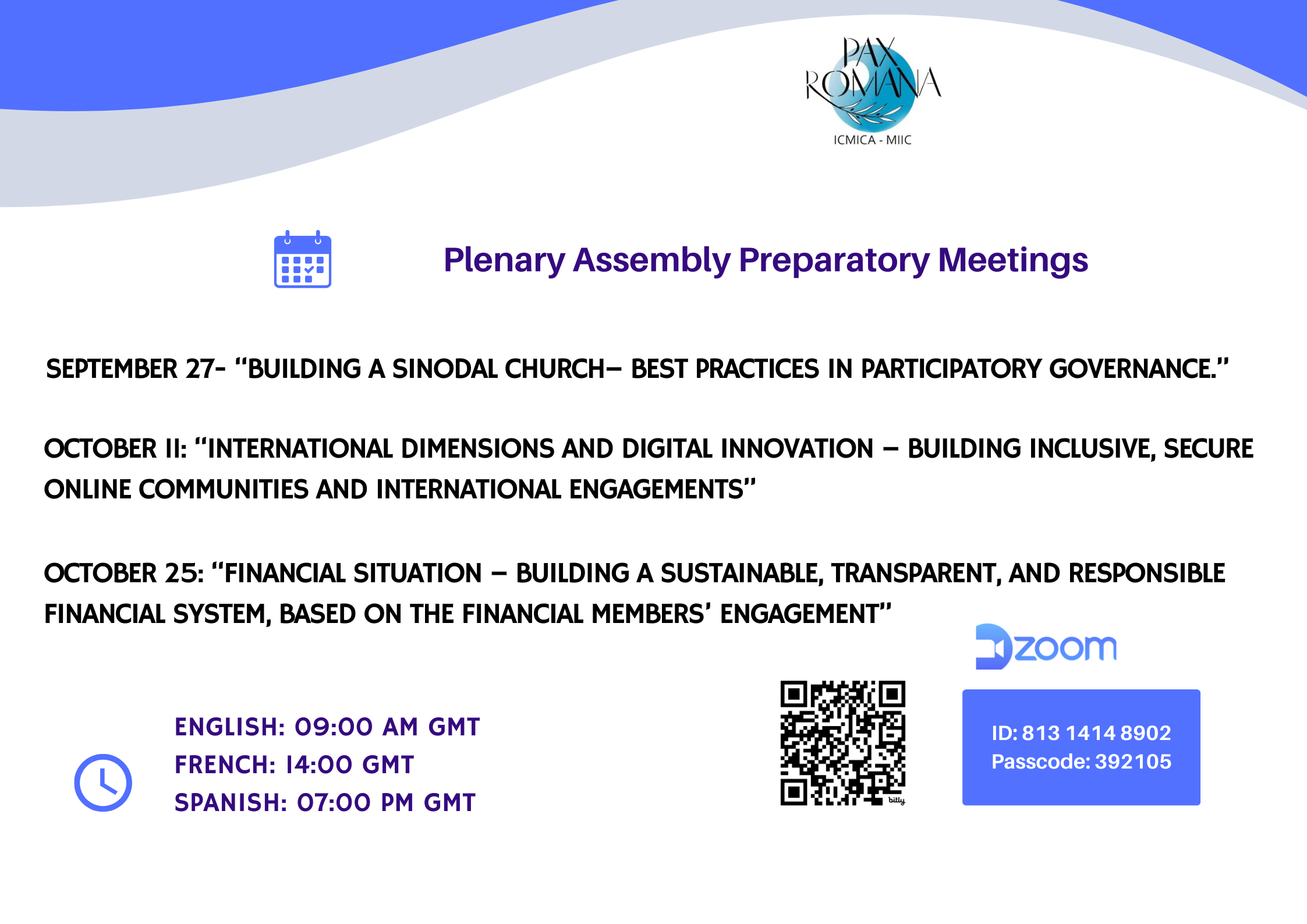
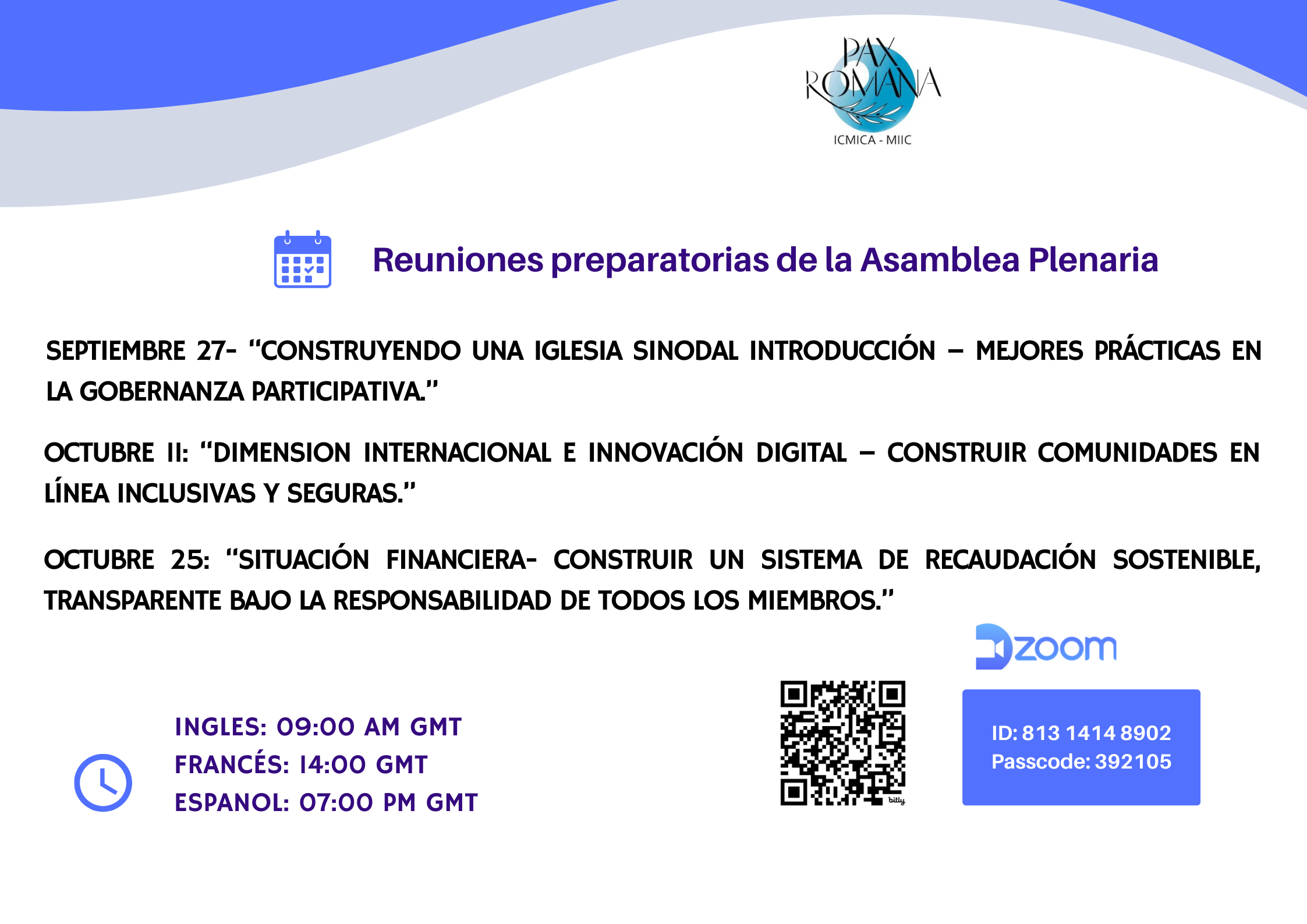
To prepare for the decision-making for the Statutory Session at the Plenary Assembly on November 15-16, three meetings will be held via Zoom on September 27, October 11, and October 25 in linguistic groups (Spanish, English, and French).
- Gather members’ expectations for the upcoming Plenary Assembly through a structured, inclusive process.
- Engage members in sharing their perspectives, define strategic priorities, and collaboratively design a four-year program plan (2026–2029) that is effective, sustainable, and in harmony with the Church’s global synodal journey
- Map key challenges and opportunities in applying synodality principles and leveraging digital innovation.
- Generate draft recommendations to be presented to the Assembly.
- Strengthen member engagement through participatory digital tools and global dialogue.
2-Programme outlines
- Opening prayers,
- Opening Speech by the President,
- Introduction of discussion purposes,
- Group discussions,
- Integration Session,
- Drafting recommendations to be presented to the Assembly.
3-Guiding questions
September 27 : “Building a Sinodal Church– Best Practices in Participatory Governance”
It is proposed that members first discuss the vision and mission of the movement (Articles 3-5 of the Statutes) and their relevance to the current ecclesial and global circumstances, while analyzing the difficulties and challenges the movement faces in fulfilling its mission. We recommend that members watch the videos of June 14 webinar. https://www.icmica-miic.org/
- What example of participatory decision-making has worked best in your context?
- How can we ensure all voices are heard, especially marginalized groups?
- What governance model could strengthen collaboration across regions?
October 11: “International Dimensions and Digital Innovation – Building Inclusive, Secure Online Communities and International Engagements”
This meeting will focus on 02 key points: the international representation and the challenges and mission of Catholic Professionals in the digital era.
1) ICMICA AND ITS ROLE IN INTERNATIONAL ORGANIZATIONS
ICMICA was founded at the end of World War II, and one of its objectives has been to participate in international affairs. It was one of the first organizations to be recognized as a non-governmental organization with consultative status in the United Nations, UNESCO, and the Council of Europe. At different times in history and in different regions of the world, it has carried out important work through its members, both by directly representing them before these organizations and through the efforts of its members at the local level, as they are direct observers of reality and can detect problems of justice that require international intervention. These issues may be environmental, human rights violations, discrimination based on gender, ethnicity, or religion, etc. Knowledge of the reality allows for the preparation of comprehensive reports on serious situations that representatives can denounce with evidence to the relevant bodies.
That is why it is important to review both the importance of ICMICA members taking on these representations in United Nations or Council of Europe bodies, and the need for members of the movement who work at the local level on various issues (peace, democracy, the environment, human rights, women’s rights, immigrants’ rights, interreligious dialogue, etc.) to coordinate at the global level through the specialized secretariats and support the representatives with documented reports.
Discussion on the meaning of the international character of the movement, the importance of our representation in international organizations (click here to know more about the current challenges), and our commitment to “act in defense of human dignity and human rights, for the construction of true peace on earth, for the eradication of all forms of poverty and injustice, and sustainable development in harmony with nature.” Art . 5.d. Statutes. Please review the current organizational structure of the movement (Chapters II and III of the Statutes) carefully, rethinking its financial sustainability in the synodal and digital age.
– How do our local movements participate in or strengthen the international work of ICMICA?
– Can we collaborate with IMCS and other church movements to increase our capacity to address the challenges of reality?
2) CHALLENGES AND POSSIBILITIES OF THE DIGITAL AGE.
The digital age presents us with many ethical challenges and opportunities for the evangelization process, as Popes Francis and Leo XIV have pointed out. Some of possible focuses of ICMICA are the following:
1. Digital Humanism: Putting the Person at the Center
- Uphold the dignity of every human person in all digital spaces.
- Advocate for technologies that serve humanity, rather than reduce people to data points or consumers.
- Encourage ethical AI, responsible data use, and inclusion of the marginalized in the digital economy.
“The digital world must be at the service of the human person, not the other way around.” — Pope Francis
2. Ethical Leadership in Technology
- Model integrity, transparency, and accountability in professional and digital work.
- Promote digital ethics in business, media, and governance — ensuring that innovation aligns with moral and social values.
- Challenge practices that exploit workers, manipulate users, or spread misinformation.
3. Building Digital Communities of Communion
- Use digital platforms to foster genuine relationships, solidarity, and dialogue — not division or polarization.
- Support faith-based networks, mentorship, and professional communities that nurture both spiritual and intellectual growth.
- Encourage “synodality online” — listening, sharing, and discerning together in digital spaces.
4. Evangelization and Witness in the Digital Sphere
- Bring Gospel values into online communication — through compassion, truthfulness, and respect.
- Engage in digital mission work, using technology to reach new audiences while maintaining authenticity and humility.
- Be present online as credible witnesses of hope and justice.
- Work toward bridging the digital divide, ensuring access to information and opportunities for all.
- Use innovation to address social and ecological challenges, in line with Laudato Si’ and Fratelli Tutti.
- Support youth and vulnerable groups to develop digital literacy and critical thinking.
6. Contemplation and Balance
- Resist digital overload and cultivate spiritual discernment in technology use.
- Integrate moments of silence, reflection, and prayer — even in a hyperconnected life.
- Encourage humane work cultures that value rest, creativity, and relationships.
- Which of the above elements/thematic are relevant to us as Catholic Professionals?
- What digital tools should be used to strengthen the work of MIIC members both at the local community level and for international work?
- What innovation could connect members globally in real time?
Vatican issued an important reflection that could guide us: you can read here
October 25: “Financial Situation – Building a Sustainable, Transparent, and Responsible Financial
System, based on the financial members’ engagement.”
The movement’s traditional financial system, which relies on fees from national federations is no longer effective. In addition to that, nowadays, Catholic agencies have less and less fund to give out, almost none for professionals’ organizations. ICMICA require responsible engagement from all members.
● Documents
1) International Budget.
Questions :
- What funding sources have been most effective for your initiatives?
- How can we ensure transparency and accountability in fund management?
- What long-term strategy could secure financial sustainability?
4-Meeting link
Please find below the Zoom link (the link remains the same for all the meetings; you can register in advance):
https://us06web.zoom.us/j/81314148902?pwd=r8WYJLDVL9IpQeqCEJR8zlPGVCLfOC.1
ID: 813 1414 8902, Passcode: 392105
5-Timing and leaders:
- The meeting in English will be at 9:00 GMT and will be led by Paulinus Prasetyo, International Vice President for Asia.
- The meeting in French will be at 14:00 GMT and will be led by Jules Zannou, International Vice President for Africa.
- The meeting in Spanish will be at 19:00 GMT and will be led by Sylvia Caceres, International Vice President for Latin America.
Leave A Comment
You must be logged in to post a comment.